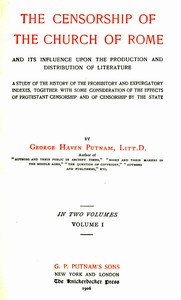
The censorship of the Church of Rome and its influence upon the production and distribution of literature, volume 1 (of 2)
by Putnam, George Haven
Publication Year
1906
Project Gutenberg Release
Project Gutenberg ID
76550
Reading Ease
Reading ease score: 47.6 (College-level). Difficult to read.
Rights: Public domain in the USA.
Summary
"The censorship of the Church of Rome and its influence upon the production and… by George Haven Putnam is a historical study written in the early 20th century. It examines how the Roman Catholic Church’s censorship—especially the Index of Prohibited and Expurgated Books and the work of the Inquisition and the Congregation of the Index—shaped what could be written, printed, and circulated. The study also compares Catholic, Protestant, and state censorship and evaluates their impact on the book trade, scholarship, and public opinion. The opening of the work lays out a detailed two-volume plan, then a preface that defines its scope: cataloging Indexes from the mid-16th century to 1900, noting earlier precedents, summarizing key decrees, describing the Roman Inquisition and the Congregation of the Index, and assessing effects on literary production, distribution, and commerce; it also names principal sources (notably Reusch) and explains the method. The introduction traces censorship from an early church ban on the Acta Pauli, shows how printing magnified the stakes, and explains the creation of the papal Index (1559), the more authoritative Tridentine Index (1564), and later practices (including expurgation). It argues the Index doubles as a historical record of literature, outlines how prohibitions affected the value and circulation of books, and notes inconsistencies among different national and ecclesiastical lists. The narrative sketches contrasting enforcement—Spain’s Inquisition as highly effective, France’s Gallican and royal controls more selective, and Italy’s mixed picture with places like Venice resisting Rome. It also touches on limits placed on vernacular Scripture and recurring condemnations of the Talmud, setting the stage for the detailed chapters that follow. (This is an automatically generated summary.)
Metadata
bookshelf
Category: History - Modern (1750+)
Category: History - European
Category: History - Religious
Category: History - Early Modern (c. 1450-1750)
language_code
en
locc_code
Z
subject
Freedom of the press
Prohibited books
Liberty of conscience
More by Putnam, George Haven
The censorship of the Church of Rome and its influence upon the production and distribution of literature, volume 2 (of 2)
1907
Authors and their public in ancient times : $b a sketch of literary conditions and of the relations with the public of literary producers, from the earliest times to the fall of the Roman Empire
1893
Books and their makers during the Middle Ages : $b A study of the conditions of the production and distribution of literature from the fall of the Roman empire to the close of the seventeenth century, Vol. II
1896
Books and their makers during the Middle Ages : $b A study of the conditions of the production and distribution of literature from the fall of the Roman Empire to the close of the seventeenth century, Vol. I
1896

The Little Gingerbread Man